
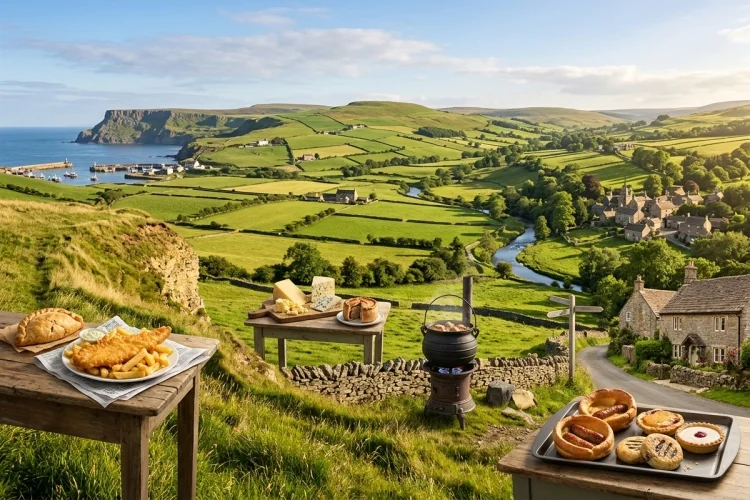

English food is often reduced to a few familiar dishes: fish and chips, a full English breakfast, and perhaps a Sunday roast. Those classics matter, but they only reveal a small part of the country’s culinary identity.
Travel from Cornwall in the southwest to Northumberland near the Scottish border, and you will discover foods shaped by completely different landscapes, industries, and local traditions.
Coastal communities developed meals around fresh and preserved fish, while farming counties became known for cheeses, sausages, pies, and slow-cooked stews. Industrial cities also created inexpensive, filling dishes for dockworkers, miners, and factory employees.
This beginner’s guide to the regional foods of England introduces some of the best-known local specialties without turning the subject into a complicated history lesson.
You will encounter savory pastries, unusual puddings, crumbly cheeses, hearty one-pot meals, and regional dishes that still inspire fierce local pride.
It is also worth remembering that English food is not exactly the same as British food. Scotland, Wales, and Northern Ireland have their own distinct culinary traditions, so this guide stays focused on England.
The North East: Simple Food Built for Cold Days
The cuisine of North East England is comforting, practical, and closely connected to its rural and coastal landscape.
One local favorite is the singing hinny, a flat griddle cake associated with Northumberland and Newcastle. It is traditionally made with flour, butter or lard, and currants.
The name is said to come from the sizzling or “singing” sound the cake makes while cooking, while “hinny” is a regional term of affection.
Another Northumbrian dish is pan haggerty, made by layering potatoes, onions, and cheese before cooking them until soft and golden. It is inexpensive, warming, and similar in spirit to a very simple potato gratin.
Along the coast, look for Craster kippers. These are herrings that have been split, salted, and smoked, giving them a rich aroma and deeply savory taste. They are often eaten at breakfast with bread or eggs.
Yorkshire: Puddings, Cheese, and Serious Comfort Food
Despite its name, Yorkshire pudding is not a dessert. It is a savory baked batter traditionally served with roasted meat, vegetables, and gravy.
The batter contains basic ingredients such as flour, eggs, and milk or water. It is poured into a hot, greased tin, where it rises and develops crisp edges with a soft, airy center. The same style of batter is used in toad in the hole, a classic dish made by baking sausages inside it.
Yorkshire is also home to Wensleydale cheese, known for its crumbly texture and mild, slightly sweet character. It may be served with fruit, chutney, or even apple pie.
For the best experience, eat Yorkshire pudding as part of a Sunday roast rather than ordering it alone. Its main job is to catch the gravy, and it performs that job extremely well.
North West England: Hotpot, Scouse, and Cumberland Sausage
Few dishes represent northern comfort food better than Lancashire hotpot. This slow-cooked meal is normally made with lamb or mutton, onions, stock, and root vegetables.
Thin slices of potato cover the top of the pot. As the dish cooks, the meat becomes tender while the upper potato layer turns golden. It was designed to cook slowly with minimal attention, making it practical for working households.
Liverpool has its own famous stew called scouse. Usually containing beef or lamb, potatoes, onions, and carrots, it developed as filling food associated with sailors and dockworkers. The dish became so closely linked with Liverpool that people from the city are still commonly called Scousers.
Farther north in Cumbria, Traditional Cumberland sausage is known for its coiled shape, coarse pork texture, and peppery seasoning. It was granted protected geographical status in 2011, helping distinguish the traditional product from more generic sausages.
The Midlands: Pork Pies and Bakewell Pudding
The Midlands contain some of England’s most recognizable baked specialties.
The Melton Mowbray pork pie, associated with Leicestershire, has a firm pastry shell filled with seasoned pork. Unlike many pies, it is usually eaten cold, making it ideal for picnics, packed lunches, and pub meals.
Its name has Protected Geographical Indication status under the UK geographical indication scheme. This means products using the registered name must follow defined requirements and have a genuine connection to the designated area.
Derbyshire offers a sweeter regional classic: Bakewell pudding. It normally combines puff pastry, jam, and a rich almond-and-egg filling.
Do not automatically call it a Bakewell tart. The better-known tart usually has a shortcrust pastry base and a smoother almond filling, while the traditional pudding is softer, puffier, and more custard-like.
Even local accounts disagree about exactly how it originated, adding to the fun of trying it in Bakewell itself.
London: Pie, Mash, and Green Liquor
London’s modern food scene includes influences from almost every part of the world, but the city also has traditional working-class dishes of its own.
The most famous is pie and mash, which developed in the East End. A basic serving includes a minced-meat pie, mashed potatoes, and a green parsley sauce known as liquor.
Despite the name, the sauce normally contains no alcohol. Its vivid color comes from parsley, and older versions were connected to the cooking liquid from eels, which were once plentiful in the River Thames.
Some historic pie shops still serve jellied eels, although their firm, slippery texture may surprise first-time visitors.
For an easier introduction, begin with a standard meat pie, plenty of mash, and parsley liquor. London establishments such as M. Manze and Goddards continue to serve versions of this traditional meal.
The South East: Seafood and Unusual Sweet Puddings
The South East of England has a strong coastal food identity. Fish and chips remain an obvious choice, but regional seafood offers more variety.
Rye in East Sussex is known for Rye Bay scallops, which are celebrated during their seasonal availability. Fresh scallops are usually best when cooked simply, allowing their natural sweetness to remain the main attraction.
Sussex is also associated with one of England’s more dramatic desserts: Sussex pond pudding. It is traditionally made by enclosing butter and sugar inside suet pastry and steaming it for several hours.
Many modern versions place a whole lemon inside. When the pudding is cut open, the melted butter, sugar, and lemon juices spill onto the plate, creating the “pond” that gives the dessert its name. It is rich, sharp, sweet, and certainly not a light ending to a meal.
The South West: Cornish Pasties, Cheddar, and Cream Tea
The South West has produced several foods now enjoyed across England, but they remain strongly connected to their original locations.
The Cornish pasty is a D-shaped pastry traditionally filled with beef, potato, swede, and onion. Its thick, crimped edge made it practical as a portable meal, particularly for workers who needed filling food away from home.
Cornish Pasty is now a registered Protected Geographical Indication. The official protection preserves its connection to Cornwall and its established production method.
Somerset is the birthplace of Cheddar cheese, although cheddar is now produced worldwide. Traditional examples range from mild and creamy to mature, sharp, and slightly crumbly.
Then there is the cream tea: scones served with jam, thick clotted cream, and tea. In Devon, the traditional order is cream first and jam on top. Cornwall famously favors jam first, followed by cream. It is a small difference that can start a surprisingly passionate conversation.
How to Explore English Regional Food
You do not need to visit every county at once. Start by choosing one region and ordering two contrasting foods, such as a savory main dish and a local dessert.
Markets, independent bakeries, traditional pubs, cheese shops, and older cafés are often better places to begin than restaurants offering a generic “British” menu. Ask whether a product is made locally and how residents normally eat it.
Protected names can also help you identify foods with a documented regional connection. Cornish Pasties and Melton Mowbray Pork Pies are examples, but England has many other protected products.
Most importantly, try regional specialties in their original context whenever possible.
A hot pasty eaten near the Cornish coast or a bowl of Lancashire hotpot on a cold afternoon usually feels more memorable than the same food purchased from a supermarket hundreds of miles away.
The regional foods of England reveal a cuisine that is far more varied than its old reputation suggests.
Yorkshire pudding, Lancashire hotpot, Cumberland sausage, Bakewell pudding, London pie and mash, Cornish pasties, and Devon cream teas all tell stories about local ingredients, working communities, and changing eating habits.
Some dishes are simple and familiar, while others – such as jellied eels or Sussex pond pudding – may require a little more curiosity. That variety is exactly what makes English regional cooking worth exploring.
Choose one region, learn about its best-known specialty, and try an authentic version at a local restaurant, bakery, or food market. Your next favorite English dish may be one you have never heard of before.