
There is something wonderfully simple about exploring England by train. You sit down, watch city streets turn into green fields, and arrive somewhere new without worrying about motorway traffic, parking spaces, or airport security.
More importantly, train travel fits naturally with the idea of slow travel.
Instead of rushing through six destinations in four days, you can spend longer in each place, use local railways for day trips, wander neighbourhoods on foot, and actually notice how one region changes into another.
A slow-travel guide to exploring England by train is not really about finding the fastest possible connection. It is about building a journey where the travelling itself becomes part of the holiday.
England is particularly suitable for this style of trip because its rail network connects major cities, historic towns, coastal destinations, and many rural areas.
VisitBritain notes that Britain’s wider network has more than 2,500 stations across England, Scotland, and Wales. The trick is resisting the temptation to visit all of them.
Why Train Travel Works So Well for Slow Travellers
Slow travel is less about moving slowly and more about travelling deliberately.
A two-hour train ride can actually support slow travel better than an eight-hour drive because you are free to watch the landscape, read, have lunch, or simply do nothing. You also tend to arrive closer to town and city centres, which makes car-free exploration much easier.
England offers another advantage: distances between many interesting destinations are surprisingly manageable.
London to Bath, for example, takes around 1 hour 20 minutes on direct services. Bath Spa station is also centrally located, meaning major sights such as Bath Abbey and the Roman Baths are within walking distance.
That allows you to spend your energy exploring rather than constantly transferring between airports, rental-car offices, and distant hotels.
Plan Fewer Stops and Stay Longer
The easiest mistake when planning an English rail holiday is turning it into a station-collecting competition.
London today. Oxford tomorrow. Bath the following morning. Bristol that evening. York after breakfast.
Technically possible? Yes.
Enjoyable? Probably less so.
A better slow-travel itinerary normally gives each base at least two or three nights. Instead of packing your suitcase every morning, choose places with useful local connections and take relaxed day trips.
Bath, for example, works well as a base for exploring parts of the West Country, while York gives you access to northern cities and countryside. Exeter can become a gateway to Devon, while towns farther west open the door to Cornwall.
This extra time also lets you experience destinations beyond their headline attraction. Stay overnight and the crowded historic centre you saw at 2pm can feel completely different during an early-morning walk.
That is where slow travellng starts becoming memorable.
Try a Slow Route Through Southern England
One particularly easy introduction is to travel west from London rather than attempting to cross the entire country.
1. London to Bath and Bristol
Begin with London, but avoid treating it as a checklist. Pick two or three neighbourhoods and explore them properly before heading west.
Bath makes an excellent second stop. The direct journey from London Paddington can take under an hour and a half, while Bristol is only around 11 minutes from Bath on the fastest services listed by GWR.
Spend a few days walking Bath’s Georgian streets, then continue to Bristol for independent food, waterfront walks, markets, and creative neighbourhoods.
There is even a Great West Way Discoverer ticket covering rail and bus travel between London, Bath, Bristol, and various branch destinations, designed specifically around a 125-mile touring corridor.
2. Continue Slowly Towards Cornwall
Instead of racing back to London, keep moving west.
Stop in Exeter or Plymouth before continuing into Cornwall. GWR’s Cornish Main Line connects London, Bristol, Exeter, Plymouth, and Penzance, while several smaller branch lines open up additional possibilities once you arrive.
London Paddington to Penzance can take a little over five hours on faster services, but slow travellers have no reason to do it all at once.
Break the journey. Explore Devon. Stay near the coast. Let Cornwall become a destination rather than merely the end of the railway line.
Head North for Historic Cities and Big Landscapes
England’s northern rail routes create a very different type of trip.
York is an obvious starting point because the historic centre is highly walkable once you leave the station. Instead of treating it as a day trip, stay long enough to explore early in the morning and after the largest visitor crowds disappear.
From Yorkshire, slower regional journeys can take you towards smaller towns and landscapes that feel far removed from London.
The famous Settle–Carlisle corridor is a particularly good reminder that the journey can be an attraction itself, running through dramatic northern countryside.
You could then continue towards Cumbria and the Lake District.
Windermere has a railway station, making it possible to reach one of England’s best-known rural regions without hiring a car, although buses and walking routes become important for exploring beyond the immediate rail corridor.
VisitBritain also highlights Britain’s scenic and heritage railways as attractions in their own right, with more than 150 heritage railways around the country.
That creates plenty of opportunities to add an intentionally slow railway day to your itinerary.
Learn the Ticket System Before You Travel
English train fares can feel confusing at first, but understanding a few categories makes planning considerably easier.
Advance tickets are generally aimed at travellers who know exactly which service they want.
National Rail says they are sold in limited numbers and are tied to the specified date and train. They usually become available up to around 12 weeks ahead, although booking horizons can vary.
They can be useful for longer intercity journeys where your plans are fixed.
Slow travel, however, often benefits from flexiblity.
Off-Peak and Super Off-Peak tickets can give you more freedom while offering cheaper fares than unrestricted options, although time and route restrictions vary.
National Rail notes that Off-Peak travel generally applies during quieter periods, with exact conditions depending on the journey.
Always check the restrictions attached to the actual ticket rather than assuming every operator follows identical rules.
Check Whether a Railcard Makes Sense
If you expect to take several trains, check Railcard eligibility before buying expensive tickets.
National Rail currently lists nine main Railcards. Most cost £35 for one year and many provide around one-third off eligible rail fares. Options include 16-25, 26-30, Senior, Family & Friends, Two Together, Veterans, and other Railcards with their own eligibility conditions.
Do the maths based on your planned journeys.
A Railcard may pay for itself quickly on several longer routes, but there is little point buying one automatically without checking whether the restrictions suit your trip.
International visitors should also investigate rail passes designed for tourists before arrival. The best option depends heavily on how many days you plan to travel and whether you value unlimited movement or cheaper pre-booked fares.
Make the Journey Part of the Holiday
The fastest train is not always the most interesting one.
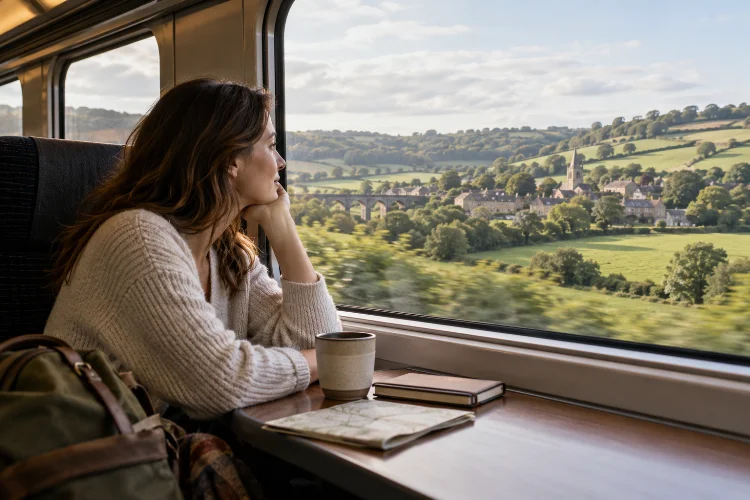
When you have the choice, consider regional services that travel through smaller towns or scenic countryside. Pick a window seat, carry a simple lunch, and avoid scheduling something important immediately after arrival.
Seat reservations are available on many longer-distance services, although not every train offers them. National Rail recommends checking with the train company and reserving early when reservations are available.
Also leave breathing room around connections.
A ten-minute transfer may look efficient on an itinerary, but constantly watching the clock works against the whole idea of slow travel. An extra 30 minutes at a station café can be much less stressful than sprinting between platforms with luggage.
Before every longer journey, check live travel information and planned engineering works too. Timetables can change, particularly around weekends, holidays, and infrastructure projects.
Travel Light and Stay Near Stations
You learn surprisingly quickly that luggage changes how enjoyable rail travel feels.
A huge suitcase becomes significantly less appealing after your third staircase, narrow platform, and busy regional train.
Pack lighter than you think you need.
Choosing accommodation within walking distance of a station also makes a big difference. You can arrive, drop off your bag, and immediately explore instead of adding another complicated transfer.
Do not assume you need to stay beside the main tourist attraction. A quieter neighbourhod between the station and city centre can provide cheaper accommodation, local cafés, and a better sense of everyday life.
That is exactly what slow travel should encourage: spending enough time somewhere to notice more than its famous landmarks.
A slow-travel guide to exploring England by train ultimately comes down to doing less, but experiencing more.
Rather than racing between dozens of destinations, choose a handful of good bases, stay several nights, and let regional trains take you into smaller cities, coastal towns, countryside, and unexpected stops.
Use Advance fares when your plans are fixed, consider Off-Peak flexibility when they are not, and check whether a Railcard could reduce your costs.
Most importantly, stop treating travel time as wasted time.
Look out of the window. Get off somewhere you had barely heard of. Stay for lunch. Take the later train.
When you give yourself that extra space, England becomes more than a collection of landmarks – it becomes a journey you actually remember.