
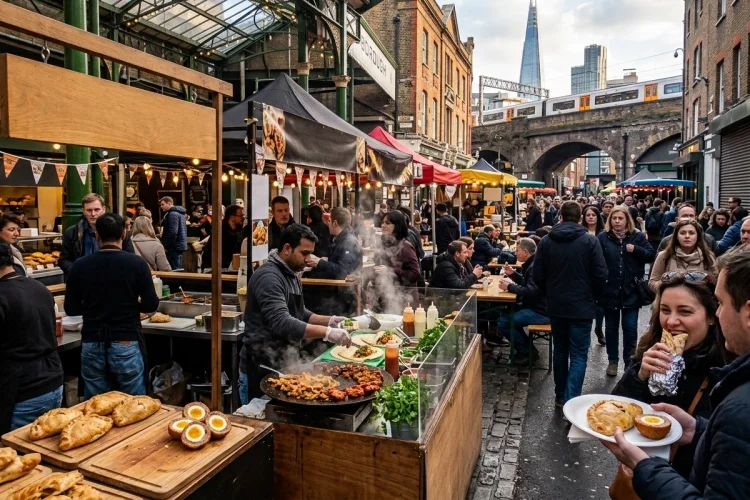

The UK’s street food scene is much more exciting than the old stereotype of bland meals and soggy chips.
Walk through a busy market in London, Birmingham, Edinburgh, Cardiff or Manchester, and you will find sizzling grills, bubbling curry pots, freshly baked pastries and queues forming around small independent stalls.
Some of the best UK street food dishes every food lover should try are traditional British favourites that have been eaten for generations.
Others reflect the country’s multicultural communities, combining flavours from India, the Middle East, East Asia, Africa and the Caribbean with local ingredients and modern cooking styles.
That mixture is what makes British street food so enjoyable. You can begin with a hot Cornish pasty, move on to an Indian kati roll and finish with a creative Scotch egg – all without sitting through a formal restaurant meal.
Whether you are planning a food-focused trip or simply exploring your nearest market, these are the dishes worth adding to your list.
Fish and Chips: The Essential British Takeaway
Few foods are more closely connected with Britain than fish and chips. The classic combination usually includes battered cod or haddock served with thick-cut chips, although the type of fish and preferred accompaniments can change from one region to another.
The best version should have light, crisp batter surrounding moist, flaky fish. The chips need to be fluffy inside rather than thin and crunchy like standard French fries.
Salt and malt vinegar are the traditional finishing touches. Depending on where you order, you may also be offered mushy peas, curry sauce, gravy, tartare sauce or a pickled onion.
Fish and chips developed as accessible working-class takeaway food, influenced by both fried-fish traditions brought to Britain by Jewish immigrants and the growth of fried potato shops.
Today, the National Federation of Fish Friers represents the industry and describes the dish as the UK’s leading takeaway meal.
For the best experience, eat it immediately. Carrying freshly fried fish around in a closed container for too long traps steam and quickly softens the batter.
Cornish Pasty: A Complete Meal Inside Pastry
A proper Cornish pasty is one of Britain’s most practical portable meals. Traditionally, it contains beef, potato, swede and onion, all enclosed in pastry and crimped along one side.
The filling cooks inside the pastry, producing a rich mixture of meat juices and softened vegetables. When made well, the shell is firm enough to hold while walking but tender enough to break apart easily.
Pasties have a long association with Cornwall’s mining communities. Their sturdy, transportable design made them suitable for workers who needed a substantial meal away from home, although historical references to pasties date back much further than the peak of Cornish mining.
You will now find versions filled with cheese, chicken, vegetables and even sweet ingredients. However, products sold under the protected Cornish pasty name must be made in Cornwall according to the recognised traditional method.
Try one warm rather than extremely hot. This allows the flavours to become clearer and reduces the risk of burning your mouth on the surprisingly steamy centre.
Scotch Eggs: The Ultimate Picnic Snack
A Scotch egg consists of a boiled egg wrapped in seasoned sausage meat, coated in breadcrumbs and fried or baked. It sounds simple, but getting all three layers right requires careful timing.
A good market version has a crisp outer shell, juicy sausage meat and a yolk that may be soft, jammy or fully set. The contrast between crunchy crumbs and rich filling makes it far more satisfying than an ordinary boiled egg.
Street food traders have also transformed the classic recipe. You may find Scotch eggs made with chorizo, black pudding, haggis, vegetarian alternatives or strongly seasoned international sausages.
They are easy to eat while exploring a market, although the larger examples can be surprisingly filling. Add mustard, chutney or a little hot sauce if you want something to cut through the richness.
Despite the name, the exact origin of the Scotch egg remains debated. Rather than worrying about where the first one appeared, focus on finding a stall that cooks them in small batches so the coating stays crisp.
Salt Beef Beigel: An East London Institution
A hot salt beef beigel is one of London’s most recognisable handheld meals. It normally combines slices of tender cured beef with mustard and pickles inside a dense, chewy bread roll.
In East London, the spelling “beigel” reflects the dish’s Jewish heritage. Brick Lane remains particularly associated with salt beef beigels, and its long-running bakeries have become attractions for both Londoners and visitors.
Visit London highlights Beigel Bake and the area’s popular hot salt beef offerings as part of the Brick Lane experience.
The ideal bite contains a little of everything: salty meat, sharp mustard, sour pickle and bread sturdy enough to hold the juices. It is messy, but that is part of the appeal.
Do not automatically ask for extra mustard before tasting it. Traditional English mustard can be much hotter than it looks, especially when generously spread across warm beef.
Haggis: Scotland’s Boldest Street Food Filling
Traditional haggis is made from seasoned sheep offal mixed with oats and other ingredients. The description can make cautious eaters nervous, but the finished dish is savoury, peppery and comforting rather than strange.
Haggis is closely connected with Scottish identity and Burns Night celebrations. Historic UK describes it as an established national icon whose fame was strengthened by the work of poet Robert Burns.
Modern Scottish vendors often make the dish easier to approach by using it as a filling. Look for haggis bonbons, loaded chips, toasted wraps or burgers topped with haggis and creamy whisky sauce.
Vegetarian haggis is also common. It usually replaces the meat with pulses, vegetables, seeds and oats while keeping the warming spices and crumbly texture.
For a first taste, try a small haggis bonbon or loaded-fries portion rather than ordering a full traditional plate. You still get the distinctive flavour without committing to a heavy meal.
Curry, Chaat and Kati Rolls: Britain’s Multicultural Comfort Food
Any honest guide to UK street food must include South Asian flavours. Indian, Pakistani, Bangladeshi and other South Asian communities have deeply influenced the way Britain eats, making curry and spiced snacks part of everyday food culture.
At street markets, dishes are often designed for quick service. A kati roll may combine flatbread with grilled meat, paneer, egg, vegetables, chutney and onions. Chaat brings together crunchy, creamy, sweet, sour and spicy ingredients in one bowl.
Borough Market’s current traders demonstrate this variety. Horn OK Please serves Indian vegetarian street food such as dosa, dosa chaat and egg kati rolls, while other stalls specialise in Middle Eastern, Singaporean, Japanese, Iraqi and Taiwanese-inspired cooking.
Ask the vendor about the spice level instead of assuming every dish will be extremely hot. Many rely more on aromatic seasoning, tangy sauces and fresh herbs than pure chilli heat.
How to Find Great UK Street Food
The easiest way to sample several dishes is to visit an established market or food hall. Borough Market combines produce traders with a dedicated street food area, while KERB operates rotating markets at different London locations.
Outside London, similar communities of independent traders can be found in cities across Britain. VisitBritain presents the country’s food scene as a mixture of regional produce, traditional pies, curries and global market cooking.
Arrive slightly before the main lunch rush when possible. You will face shorter queues and have more time to ask traders about ingredients, spice levels and dietary options.
Avoid ordering the largest item from every stall. Sharing smaller portions allows you to taste more dishes without becoming full after your first stop.
Most importantly, stay open-minded. The best British street food experience may be a centuries-old local speciality, a family recipe brought from another country or a completely new combination created by an independent cook.
The UK street food scene tells a much bigger story than fish and chips alone. Traditional dishes such as Cornish pasties, Scotch eggs and haggis sit comfortably beside salt beef beigels, Indian kati rolls and a constantly changing selection of international market food.
Each dish offers a different view of British food culture. Some are shaped by regional history, while others show how migration and independent businesses continue to influence what people eat across the country.
Start with the classics, but leave room for something unfamiliar. Visit a local food market, order from a small trader and share a few portions with friends. Your next favourite British meal might come from a paper bag rather than a restaurant plate.