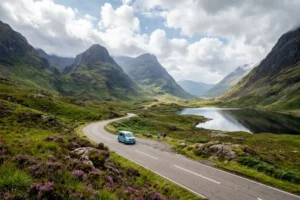
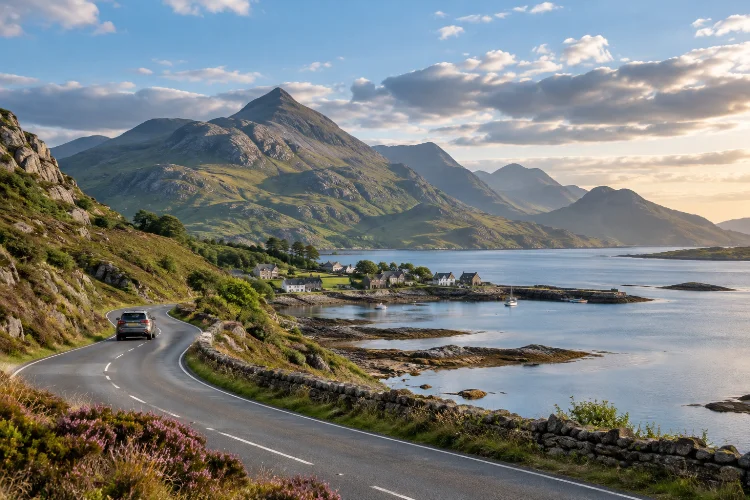

Mention a Scottish road trip and the North Coast 500 usually appears within seconds. The famous Highland loop deserves its reputation, but Scotland has far more to offer drivers than one heavily photographed route around the far north.
Head south, east, or west and you will find roads winding beside sea lochs, climbing through mountain passes, crossing whisky country, and connecting fishing villages where stopping for lunch feels more important than reaching the next destination quickly.
Some alternatives are also much shorter, making them easier to fit into a long weekend.
This guide explores Scotland’s most scenic road trips beyond the North Coast 500, from the 300-mile coast-and-mountain circuit of the south-west to the compact Kintyre Peninsula and the dramatic high roads of the Cairngorms.
None needs to be treated as a race. Give yourself time for unexpected viewpoints, castle detours, beach walks, and the occasional sheep-related traffic jam. That is usually where the best Scottish road-trip memories begin.
1. South West Coastal 300: Scotland’s Underrated Southern Loop
If you like the idea of a circular touring route but want to look beyond northern Scotland, the South West Coastal 300 is an excellent place to begin.
The SWC300 covers 300 miles through Dumfries & Galloway and south Ayrshire, starting and finishing in Dumfries. VisitScotland recommends allowing around three to four days, although stretching it to a week gives you much more time for walks and detours.
The scenery changes constantly. You get the Solway coastline, sandy beaches, forest landscapes, quiet villages and upland roads.
Highlights include the Mull of Galloway, Scotland’s most southerly point, as well as Wanlockhead, described by VisitScotland as Scotland’s highest village.
This route works particularly well for travellers who enjoy mixing scenery with castles, gardens and small towns rather than spending every day in huge Highland landscapes.
Best for: quiet coastlines, history and a relaxed three-to-seven-day road trip.
2. SnowRoads Scenic Route: For Proper Mountain Driving
Want something dramatically different? Head into the eastern Cairngorms.
The SnowRoads Scenic Route runs for around 90 miles between Blairgowrie and Grantown-on-Spey, crossing some of Britain’s highest public roads. VisitScotland gives a basic driving time of roughly three hours, but doing it that quickly rather misses the point.
The roads rise through open moorland, mountain valleys and high passes where the landscape can feel enormous. Braemar, Glenshee and Tomintoul provide natural places to slow down, eat, walk or stay overnight.
The name is not just clever marketing. These elevated roads can be among the first affected by snow, so weather conditions matter considerably outside the warmer months.
Allow a full day at minimum. Two days is even better if you want to turn the drive into an actual Highland break rather than a scenic commute.
Best for: mountain scenery, photography and dramatic high-altitude roads.
3. Argyll Coastal Route: Lochs, Mountains and the West Coast
Scotland’s west coast delivers classic scenery without requiring you to travel anywhere near the NC500.
The official Argyll Coastal Route stretches approximately 129 miles from Tarbet to Fort William. It follows a landscape of sea lochs, wooded shores, mountains and coastal settlements, with VisitScotland estimating just under three hours of pure driving time.
Of course, you should take much longer.
Inveraray makes a natural stop, while the wider route towards Oban and Glencoe opens up opportunities for seafood, castles, short walks and waterfront views. Continue towards Fort William and the scenery becomes increasingly mountainous.
If you have more time, this route can form part of a much bigger west-coast adventure incorporating Mull, Ardnamurchan and Skye. VisitScotland features a flexible west-coast itinerary covering roughly 480 miles through Argyll, island landscapes, Glencoe and Skye.
Best for: first-time Highland visitors who want lochs, mountains and coast in one trip.
4. North East 250: Castles, Coast and Whisky Country
The North East 250 feels almost like several road trips combined into one.
This 250-mile circular route passes through the Cairngorms, Royal Deeside, Moray Speyside and Scotland’s north-east coastline. Instead of one dominant type of landscape, you move between mountains, farmland, beaches, historic estates and whisky-producing country.
That variety makes the NE250 ideal when people in the same car want different things.
One day can revolve around mountain scenery near the Cairngorms; another can involve coastal villages. Speyside introduces distilleries and river valleys, while Royal Deeside brings castles and forested countryside.
Aberdeen is an obvious starting point, although a circular route means you can join wherever works best for your itinerary.
Do not try to squeeze the whole thing into one frantic day. Three or four days gives you room to explore rather than simply watch attractions disappear through the windscreen.
Best for: whisky, castles, coastal scenery and varied landscapes.
5. Kintyre 66: A Small Road Trip With Big Coastal Views
Not every Scottish road trip needs hundreds of miles.
The Kintyre 66 is a 66-mile route around the Kintyre Peninsula in Argyll, making it one of the most manageable options in this guide. VisitScotland recommends two to three days if you want enough time to explore its six areas properly.
Campbeltown provides a useful base, while coastal roads lead towards beaches, small communities and views across to neighbouring islands. Saddell Bay offers views towards Arran and Ailsa Craig, while the peninsula also provides opportunities for wildlife watching.
Some sections of the east coast and Gigha use single-track roads, so slower driving is part of the experiance. Passing places are for allowing vehicles through, not for parking while you take photographs.
This is a great choice when you want remoteness without committing to an enormous itinerary.
Best for: short road trips, beaches, wildlife and quieter west-coast scenery.
6. Fife Coastal Route: An Easy Scenic Drive Near Edinburgh
For something shorter and more accessible, look east.
The Fife Coastal Route runs for around 77 miles between Kincardine and Newport-on-Tay, with VisitScotland estimating a little over two hours of driving without stops.
But again, stopping is the whole idea.
The route combines views of the Forth bridges with farmland, beaches and attractive coastal communities. St Andrews is the obvious famous destination, but the neigbouring fishing villages and shoreline are what give the journey its character.
Because the route is relatively compact, it works nicely as a two-day escape from Edinburgh or as part of a longer eastern Scotland itinerary.
You could drive sections, stop for seafood, walk stretches of the nearby Fife Coastal Path and continue when you feel like it. That slower approach suits the area far better than rushing from one landmark to another.
Best for: weekend trips, fishing villages and travellers starting around Edinburgh.
7. How to Make a Scottish Road Trip Better
Scotland rewards flexible itineraries.
A route described as a three-hour drive can easily become an eight-hour day once you include viewpoints, cafés, walks and weather. Avoid planning every stop to the minute.
Single-track roads deserve particular attention. Use passing places correctly, allow faster local traffic to pass and never park in them.
On remote routes, fuel or EV charging options can also be more limited than in major towns, so plan ahead. VisitScotland specifically advises travellers to research driving conditions and practical requirements before setting out.
Weather can change quickly, especially in mountainous areas. Check conditions each morning rather than relying on the forecast you saw three days earlier.
Also book accomodation early during summer. Popular areas can fill up even when the roads themselves feel quiet.
Most importantly, resist the urge to cover huge distances. Scotland looks compact on a map, but narrow roads, scenic stops and slower rural sections mean journey times can grow surprisingly fast.
The North Coast 500 may be Scotland’s most famous driving route, but it is far from the country’s only great road trip.
The South West Coastal 300 offers beaches and quiet southern landscapes, the SnowRoads climb through the Cairngorms, and the Argyll Coastal Route combines lochs with classic Highland scenery.
Meanwhile, the North East 250 brings together whisky country, castles and coastline, while Kintyre and Fife prove that a memorable trip does not need to cover hundreds of miles.
Choose your route based on what you actually enjoy rather than simply following the most famous itinerary.
Then give yourself extra time, leave gaps in the schedule and pull over when a view catches your attention. The best Scottish road trips are rarely about arriving quickly – they are about everything that makes you stop along the way.