
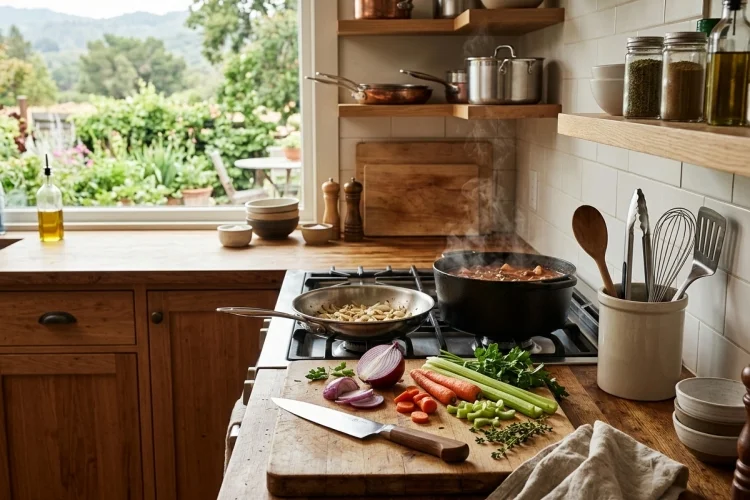

Walk into a kitchen store and you will find a gadget for almost everything. There are avocado slicers, electric egg cookers, strawberry hullers, banana cutters, and dozens of other tools designed to solve extremely specific problems.
Most of them will eventually end up forgotten in a drawer. A practical kitchen does not need to be packed with equipment.
It needs a small collection of reliable tools that can handle many different tasks. The best essential kitchen equipment you will actually use should make preparing, cooking, serving, and cleaning food noticeably easier.
That does not mean buying the most expensive products available. A comfortable knife, a stable cutting board, a few versatile pans, and several basic utensils can take you surprisingly far.
The right equipment should also match the way you cook. Someone who makes soup every week has different priorities from someone who mainly prepares stir-fries or baked dishes.
This guide focuses on useful, multipurpose kitchen essentials rather than trendy gadgets. These are the items that earn their storage space by helping with everyday meals again and again.
Start with Fewer, More Versatile Tools
Before buying anything, think about how often you will realistically use it. A tool that performs one highly specific task may sound convenient, but it can quickly become clutter if you only need it twice a year.
Multipurpose kitchen tools usually offer better long-term value. A chef’s knife can replace vegetable choppers, garlic cutters, herb scissors, and several other single-purpose gadgets.
A sturdy Dutch oven can handle soups, stews, braises, pasta sauces, deep-frying, and even bread.
Serious Eats recommends building a starter kitchen around flexible basics such as knives, cutting boards, skillets, pots, sheet pans, mixing bowls, and simple hand tools.
The goal is to create an efficient setup without spending money or storage space on equipment that rarely leaves the cupboard.
When considering a purchase, ask one simple question: “What else can this do?” The more useful answers you can think of, the more likely the item deserves a place in your kitchen.
A Chef’s Knife and a Stable Cutting Board
A good chef’s knife is probably the most important piece of food preparation equipment. It can chop onions, slice meat, mince herbs, crush garlic, dice vegetables, and handle most daily cutting tasks.
An eight-inch chef’s knife is a common starting point because it offers enough blade length for larger ingredients while remaining manageable for most home cooks.
You may eventually add a small paring knife for detailed work and a serrated knife for bread, tomatoes, and delicate cakes, but the chef’s knife should come first.
Comfort matters more than brand recognition. Hold the knife when possible and pay attention to its balance, weight, handle shape, and grip. An expensive blade that feels awkward in your hand will not be as useful as a moderately priced knife that feels natural.
Pair it with a large, stable cutting board. There should be enough room to chop ingredients without constantly pushing them aside. Place a damp kitchen towel underneath the board if it slides across the counter.
Avoid cutting directly on glass, marble, or ceramic surfaces because hard materials can dull a knife quickly. A wooden or quality plastic board is generally kinder to the blade and easier to work on.
A Skillet for Everyday Cooking
A skillet is where much of everyday cooking happens. You can use it for eggs, pancakes, sautéed vegetables, fish, chicken, burgers, pan sauces, and countless one-pan meals.
A stainless-steel skillet is durable, versatile, and excellent for browning food. It also allows flavorful browned bits to form on the surface, which can later be loosened with stock, water, or wine to make a quick sauce.
A cast-iron skillet is another valuable option. It retains heat well and can move from the stove to the oven, making it useful for searing meat, roasting vegetables, baking cornbread, or preparing skillet pizza.
A basic kitchen equipment guide from Bob’s Red Mill describes cast iron as a highly adaptable choice for foods ranging from eggs and vegetables to pork chops.
A small nonstick pan can still be convenient for delicate foods such as eggs, crepes, and flaky fish. However, it should not be your only pan because nonstick coatings are less suitable for very high heat and usually do not last as long as stainless steel or cast iron.
A Saucepan and a Larger Pot
You do not need a matching ten-piece cookware set. For many households, one medium saucepan and one larger pot will cover most stovetop needs.
A two- or three-quart saucepan is useful for rice, oatmeal, boiled eggs, small portions of pasta, reheating soup, and making sauces. Look for a comfortable handle and a lid that fits securely.
For larger meals, choose a stockpot or Dutch oven. A stockpot is lighter and useful for pasta, broth, corn, and big batches of soup. A Dutch oven is heavier but more versatile because it retains heat and performs well both on the stove and inside the oven.
Think about the quantities you normally cook. A huge pot may seem useful, but it can be inconvenient to wash and store if you usually prepare food for only one or two people.
Sheet Pans and Oven-Safe Baking Dishes
A rimmed sheet pan is not limited to baking cookies. It is one of the easiest tools for preparing complete meals with minimal cleanup.
Use it to roast vegetables, toast nuts, bake chicken, cook fish, reheat leftovers, or prepare a sheet-pan dinner. The raised edges keep oil and cooking juices from running into the oven.
A half-sheet pan is especially versatile, provided it fits your oven. Adding a wire rack allows air to circulate underneath food, which can improve browning and keep roasted ingredients from sitting directly in released liquid.
Sheet pans and cooling racks are included among the practical basics recommended for a starter kitchen by Serious Eats.
A medium glass, ceramic, or metal baking dish is also helpful for casseroles, lasagna, baked pasta, brownies, and roasted side dishes. Choose a size that matches your usual portion needs rather than buying several nearly identical dishes.
Mixing Bowls, a Colander, and Measuring Tools
A set of nesting mixing bowls takes up relatively little room and supports dozens of kitchen tasks. Use them for mixing batter, tossing salads, marinating meat, whisking dressings, storing prepared ingredients, or serving snacks.
Stainless-steel bowls are lightweight, durable, and difficult to break. Glass bowls are heavier but allow you to see the contents clearly and may be microwave-safe, depending on the manufacturer’s instructions.
A sturdy colander is another everyday essential. Beyond draining pasta, it can rinse vegetables, wash rice, clean beans, and hold leafy greens. Measuring cups and spoons are helpful for sauces, dressings, baking, and unfamiliar recipes.
A digital kitchen scale is even more useful for baking because weight measurements are often more consistent than volume measurements. It can also help with dividing dough, portioning ingredients, and following recipes written in grams.
Simple Utensils That Handle Most Jobs
Kitchen utensils do not need to come in a giant matching set. A few carefully chosen pieces can cover nearly everything.
A wooden spoon is gentle on cookware and useful for stirring soups, sauces, grains, and stews. A heat-resistant silicone spatula can scrape bowls, fold batter, stir scrambled eggs, and remove sauce from the corners of a pan.
Locking metal tongs act like heat-resistant extensions of your hands. They can turn meat, toss pasta, move roasted vegetables, serve salad, and retrieve food from hot pans.
A flexible metal turner is useful for flipping fish, pancakes, burgers, and fried eggs. Serious Eats considers wooden spoons, tongs, silicone spatulas, and flexible turners among the most useful hand tools for regular cooking.
Add a whisk, vegetable peeler, can opener, and fine-mesh strainer, and you will be equipped for most common recipes.
A Food Thermometer for Accuracy and Safety
A food thermometer may not look exciting, but it is one of the most valuable tools in the kitchen. It removes much of the guesswork from cooking meat, poultry, fish, casseroles, and leftovers.
Color and texture alone cannot always confirm whether food has reached a safe temperature. FoodSafety.gov recommends checking the thickest part of food with a thermometer while avoiding bones, fat, and gristle.
Whole cuts of beef, lamb, pork, and veal should generally reach at least 145°F or 63°C and rest for three minutes. Ground meat should reach 160°F or 71°C, while poultry and leftovers should reach 165°F or 74°C.
An instant-read model is especially practical because it provides fast results without remaining inside the oven. It can help prevent both undercooking and the dry, overcooked texture caused by leaving food on the heat for too long.
Small Appliances Should Match Your Habits
Not every kitchen needs a stand mixer, food processor, pressure cooker, blender, air fryer, rice cooker, and slow cooker. Small appliances are only essential when they support the food you genuinely prepare.
A blender makes sense if you regularly make smoothies, soups, sauces, or dressings. A food processor is useful for frequent baking, shredding, chopping, and large-batch preparation, but it may not justify the storage space for occasional use.
A rice cooker can be valuable in a household that eats rice several times a week. An electric kettle is practical for tea, coffee, noodles, and recipes requiring hot water.
Wait until a repeated cooking problem becomes obvious before purchasing an appliance to solve it.
This approach helps you avoid buying equipment for an imagined future version of yourself who makes fresh pasta, homemade ice cream, or elaborate pastries every weekend.
How to Choose Equipment That Lasts
Durability is not always connected to the highest price. Look for solid construction, comfortable handles, stable bases, replaceable parts, and materials that suit your cooking style.
Check whether an item is easy to clean. Equipment with awkward corners, complicated attachments, or delicate surfaces may become frustrating enough that you stop using it.
Storage also matters. Nesting bowls, stackable containers, and cookware with manageable dimensions are easier to live with in a small kitchen.
Keeping frequently used equipment organized and accessible can also reduce preparation time because you are not searching through crowded drawers before every meal.
Whenever possible, buy individual items instead of large sets. Sets often include several sizes or utensils that look useful but rarely match your actual cooking routine.
The most useful kitchen is not necessarily the one with the most equipment. It is the one filled with dependable tools that support the meals you prepare regularly.
Start with a comfortable chef’s knife, a stable cutting board, a versatile skillet, a saucepan, a larger pot, a sheet pan, mixing bowls, and several reliable utensils. Add measuring tools and a food thermometer for greater consistency and safety.
Small appliances and specialty equipment can come later, once your cooking habits show that you genuinely need them.
Before buying another gadget, consider how often you will use it, how many tasks it can handle, and where you will store it. Build your kitchen gradually, choose useful equipment over novelty, and let every item earn its place.